Showing posts with label Greek elections. Show all posts

Friday, 24 June 2016

Η Βρετανία ψήφισε έξοδο από την Ευρωπαική Ένωση

Δυστυχώς οι φόβοι μου για επικράτηση του BRexit, μέχρι στιγμής επιβεβαιώνονται ...
το αποτέλεσμα είναι δύσκολο για το BRemain (ο Κάμερον θα πάει στο σπίτι του, το εργατικό κόμμα θα διασπαστεί και άλλα), αλλά το φιλοευρωπαικό ποσοστο είναι υψηλό, είναι συμπαγές και κοντά στην πλειοψηφία ...
αλλά κατά τη γνώμη μου, το αποτέλεσμα είναι ακόμα πιο δύσκολο για το BRexit. Κι αυτό γιατί όπως και στην Ελλάδα, η απόφαση είναι εξαιρετικά δύσκολο να υλοποιηθεί (ασχέτως νομίσματος) και η ηγεσία του BRexit είναι άλλα ντ'άλλων. Ήδη η στερλίνα έχει υποτιμηθεί στο χαμηλότερο σημείο από το 1985 στο 1,3459 ή -9% υποτιμηση μέχρι τώρα...
Το νησί εισέρχεται με λαική εντολή σε μία δίνη προβλημάτων και εσωτερικών αντιπαραθέσεων που ξεπερνά τις δικές μας κλασσικές αντιπαραθέσεις ... 
Αλλά στην πορεία η κατάσταση θα μεταβληθεί υπερ της παραμονής και στο τέλος, εκτιμώ ότι η Μεγαλη Βρετανία (ολοκληρη ή κομμάτι-κομματι) θα παραμείνει στην ευρωπαική οικογένεια

Tuesday, 22 September 2015

Sep 22nd, 2015, Tsipras returns to Maximos Mansion but new bipartisan government’s time horizon may be short term


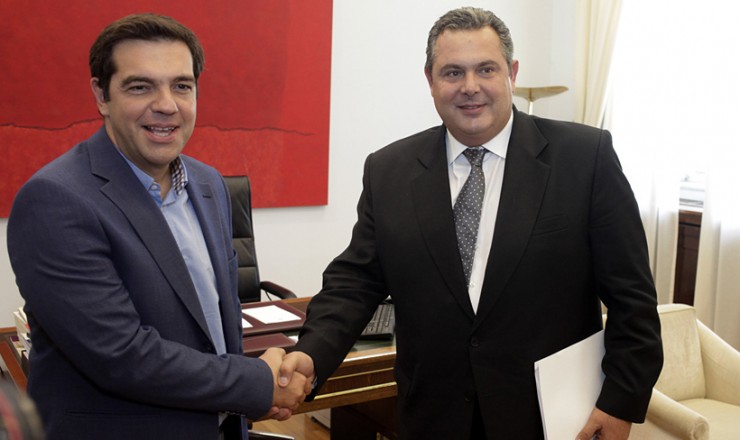
  • Tsipras (leftish) was sworn in as Greece’s Prime Minister after his personal triumph in Sunday’s  elections, and his agreement with Independent Greeks (nationalists) to form coalition government.
 
  • However, the total number of MPs who will support Tsipras’ new government is 155 (out of 300), which consists of 145 SYRIZA MPs and 10 of Independent Greeks ones. The new coalition government is supported by 7 MPs less compared to his previous coalition government, which was 162 MPs (149 SYRIZA’s MPs and 13 Independent Greeks).

  • The head of the European Parliament, Martin Schulz, questioned the decision made by Greek leftist Alexis Tsipras to renew a coalition with the extreme right-wing Independent Greeks party.  

  • New Democracy’s Meimarakis announced a party conference to elect the new leader of Opposition, in October.  

  • Elections abstention was increased significantly in Sundays’ elections i.e. 5.57 mios voted in Sunday’s elections compared to 6.33 mios voted in Jan’15, and 2.05 mios who voted in 2009. This is translated to a reduction of 1.5 voters during the 6 years period of austerity. Although Tsipras maintained his power, in terms of percentage of total voters, SYRIZA received 320K less votes compared to last January (1.93 vs. 2.25 mios). 
 
Greece’s new government has to ratify by mid-October, a set of new measures of approx. 3-5 bios euros (1.5-2.5 % of GDP) such as: 
    1. the increase in the tax rate on farmers to 20% in 2016 and to 26% in 2017, from 13% today
    2. the tax on TV adverts, the tender for the auctioning of TV channel licenses,
    3. the increase in the tax on rental incomes from 11 to 15% for annual earnings of up to 12,000 euros and from 33 to 35% for greater earnings,
    4. the gradual abolition of the special tax status for the shipping sector. 
  • On the other hand, Greece's debt due increased to approx. 7 bios euros during the first 8 months of 2016 while old debt amounts to 72.18 bios euros (44.4% of GDP)
  • last but not least, the new government will have to complete Greek Banks' recapitalization.
 Risk assessment: The elections’ result was Tsipras' personal triumph, who gambled on the snap elections last month to see off a revolt by party radicals over his U-turn on accepting more tough austerity measures in exchange for Greece’s third international bailout.
Although the country’s risk profile has been substantially improved since early July, uncertainty remains at comparatively higher levels compared to rest of Eurozone; this is related to the implementation risk of 3rd MoU and sustainability of new government.
For instance, the 10 yr. bond yield fluctuates close to 8.3% vs almost 20% in July 10th In addition, the bipartisan coalition government may have a short term time horizon due to the following reasons:
·         Tsipras return to Maximos Mansion (Prime Minister's Office) with his hands tied due to the 3rd MoU.
·         Although the percentage of abstention (45%) is not reliable because electorate’s lists are not automatically updated, the significant reduction of voters (-1.5 mios since 2009) represents a significant factor of uncertainty.
·         The 3rd MoU is frontloading in terms of implementation of structural reforms. The new Tsipras’ government will have to implement a significant number of new measures by end October, which appears highly uncertain considering the various statements of newly elected MPs.
·         It is highly unlikely that pro Europe political parties such as New Democracy, PASOK, Potami and Centrist Union will either offer vote of confidence or support new government’s legislation.
·        the formation of a bipartisan government between leftish SYRIZA and extreme right Independent Greeks, is considered as an opportunistic alliance without any ideological and or strategic substance. It also represents a show stopper to receive any support by other pro Europe political parties.
·        the new set of structural reforms will impact significant vested interests such as farmers, pharmacists, pensioners and state employees (due to privatization plan).
·         Although Tsipras has cleared his parliamentary group from the Eurosceptic Leftish Platform,  it is highly likely that he will face issues from the so call ‘Movement of 53’ which represents his new internal opposition.
Tsipras will need to cancel his coalition with Independent Greeks, in order to secure the form of the other two pro Europe, centre-left political partes and form a three party coalition government i.e PASOK (17 MPs) & Potami (11 MPs) . This government will have centre-left political orientation according to European standards and a total number of MPs 173 (145 + 17 + 11) .
It is highly unlikely that either New Democracy (due to its conference) or Centrist Union (new party) will join a coalition government with SYRIZA, at this stage.

Monday, 21 September 2015

Sep 21st, 2015, Greece gradually returns to European normality

·         In contrast to all polls which were showing a neck-and-neck battle, Tsipras managed to win elections by 7.5% points vs. New Democracy (35.54% vs. 28.03%), and maintained last January’s popularity and stayed in power.  

·         Greece’s new Parliament will consist of 8 political parties; the Centrist Union which is a pro Europe, one-man-show political party managed to enter the parliament after three decades of political struggle.   

·         The new Eurosceptic party named Popular Unity ,which was formed after SYRIZA’s rupture, failed to surpass the threshold of 3% and stays out of parliament.

Risk assessment.
·         Greece’s risk profile further improves after elections. SYRIZA and Independent Greeks will form government based on the pro Europe agenda which is included in 3rd MoU. This is development of immense importance, considering fluid regional geopolitics and local deteriorating economic conditions.  Although implementation risk remains, it follows a decreasing trend.
 
·         These elections are considered as Tsipras’ personal political victory. Tsipras thrashed political opponents, eurosceptics and pollsters.  

·         The new Parliament is more centrist and more pro Europe compared to previous one. In addition, SYRIZA and Independent Greeks can form government and will be supported by other pro Europe political parties, in case of crucial legislation regarding structural reforms. However implementation risk remains especially in areas such as privatisations, farmers and pensions. 
·         Greece’s pro Europe parliament is in line with local public opinion which favours euro (70-80%). This is translated to a gradual transition from previous vote of protest to a comparatively more rational one.
·         Although some of Friday’s polls were showing SYRIZA’s lead by 3%, this was not the case during the pre-election period during which they were showing a neck-and-neck battle. Once more local pollsters failed to predict results during pre-election period. The same applies on exit polls which were showing SYRIZA’s narrow lead with overlapping vs New Democracy. 

·         In brief, yesterday’s elections brought to surface three surprises:

1.        SYRIZA’s lead by 7.5% points despite the U-turn which occurred as regards the July 13th agreement and 3rd MoU.

2.       SYRΙZA’s ally Independent Greeks (nationalists) managed to surpass the 3% threshold (3.67%) and enter parliament, despite polls of all previous weeks which were showing the opposite.

3.       The new Eurosceptic, ex-SYRIZA political party named LAE failed to surpass the 3% threshold (2.6%) and was left out of parliament. This occurred despite the fact that a significant number of former SYRIZA’s executives, the significant number of its Central Committee and the majority of its Youth's Central Council were supporting it. For instance, the former Finance minister Varoufakis, the former minister of Energy Lafazanis, the former minister of Pensions Stratoulis and most importantly the Former Speaker of Commons Constantopoulou, the ex MEP and Leftish icon Glezos were among LAE's supporters/candidates. 

·         New Democracy (centre right) has lost elections but slightly increased its popularity vs last January’s one (28.03% vs 27.81% in January). It lost elections mainly to the following reasons:

1.       Despite the fact that the 3rd MoU represents Tsipras’ U-turn, he achieved to neutralise ND’s competitive advantage which was its pro Europe stance.     

2.       ND is still an old-fashioned political party, which is dominated by various local and country-level Barons.

3.       Its political message needs to adjust to new conditions i.e. refugee crisis, social inclusion, unemployment, youth, Balkans etc.

4.       ND’s leader performance was better than expected. However, he was not a new face in local politics and appeared as he had a special purpose role (he didn’t achieve to change any candidate).  
 
5.       Greece centre right will go through a significant restructuring process, in the coming months.

·       the other pro-reform, pro Europe, centre left/liberal party named Potami suffered significant losses vs last January, despite the inclusion of significant number of famous professionals, academics and politicians. It becomes obvious that being professionally competent and successful, doesn’t make automatically a well-accepted politician.


·         Last but not least, abstention increased to levels close to 45% which represents a historical high. It becomes evident that the significant number of elections (7 parliamentary elections, 1 referendum, 3 municipal during the last 11 years) have caused a fatigue to local electorate.


Saturday, 19 September 2015

Sep 19th, 2015, Greece is heading on a neck and neck elections, but a string of latest polls indicate SYRIZA’s marginal lead


·         Greece elections continue to appear as a neck and neck battle. After last Wednesday’s polls which were showing a narrow lead of New Democracy, eight polls were published during the last two days indicating a marginal lead of SYRIZA, which varies from 0.5 up to 3.0%.  

·         All polls were showing that Golden Dawn (neo Nazi) will end up third, and three political parties will be fighting to surpass the threshold of 3% and enter in the next parliament i.e. Union of Centrist (pro Europe, one man show party), Popular Unity (former SYRIZA euro sceptics) and Independent Greeks (former Tsipras’ government ally). Last but not least, undecided/undefined voters are recorded above the level of 10% which is crucial for the final outcome.

·         In an effort to attract the undecided voters, the two main rivals avoided to talk about the real agenda and used tough accusations against their rivals on corruption related matters. More specifically:

o   SYRIZA’s Tsipras urged the Greek voters during his last speech at Syntagma Square that these elections represent the last opportunity to battle with Greece’s elites and corruption, which are linked to New Democracy.

o   New Democracy’s Meimarakis during his interview at SKAI TV station accused SYRIZA that is heavily involved in corruption mentioning a) the last conflict of interest case of Flabouraris, who is the former minister of state and mentor of Tsipras and b) that there are SYRIZA’s MPs who made profit out of Grexit scenario, implying the number of SYRIZA's ministers who withhold investment portfolios which also includes hedge funds.

·         ECB’s Draghi urged Greece to reform its pension system in order to prevent it from its collapse.  According to Reuters, Draghi mentioned in his response to a MEP’s request that “The sustainability of the pension system is crucial from a social fairness perspective, not least because it is necessary to ensure that the Greek state remains able to pay pensions in the longer term,”.

·         According to Greek Tourism Federation, the tourists arrivals at Greece’s airports increased +by 6.3% during the Jan-Aug period (vs. +16.5% during the same period last year). According to Greek Statistics Authority (HELSTAT), the total turnover generated by tourism increase by +10.9% during Jan-Jun period (vs an increase of +17.2% during the same period last year). It appears that the turnover increase during the 2nd quarter of 2015 showed an increase of 13.4% vs. an increase of 6.7% which occurred during the 1st quarter 2015.

·         The services sector of Greek increased its share to 85.2% of GDP according to HELSTAT. It appears that services sector has gradually increased its share from 82.1% in 2010, due to tourism. The total number of tourists arrivals for 2015, is expected to cross the level of 25.5 mios which represents an increase of 8-10%.

Risk assessment. It is still very difficult to predict Greece’s elections outcome. Undecided voters (>10%) will determine the final outcome. In addition, weather forecast indicate a glorious Sunday, which increases probability to keep a number of voters away.
In general, the probability of a Grexit scenario has been diminished dramatically and secondly the country risk profile has been significantly lowered compared to the period before July 13th. This is also reflected to the 10 year bond yield which dropped below 8.30% yesterday (compared to close to 20% before July 13th).
These elections are very different compared to all previous ones because the previous dilemmas such as memorandum vs. anti-memorandum, Europe vs. Grexit have ceased to exist. In these elections, most political parties agree on euro, implementation of 3rd MoU and structural reforms.
In addition, it is highly likely that no political party will win the majority of next parliament. But even if there is a majority, it is highly unlikely that Greece will have one-party government.
It is highly likely that the 2 out of three, small political parties which struggle to enter in the next parliament, will fail to achieve this target. Assuming that the next parliament will have 7 political parties and no parliamentary majority, we could have the following scenarios
1.       SYRIZA win. Tsipras has rejected the ‘Grand Coalition’ scenario, hence he will aim to achieve a coalition government with PASOK, Potami and LAE (if it achieves its entry in next parliament).

a.       SYRIZA won’t be able to form a coalition government with LAE because a) there is no ground for an agreement as regards the implementation of 3rd MoU b) PASOK and Potami won’t agree to participate in a coalition government with a Eurosceptic party such as LAE.

b.      SYRIZA will aim to form a coalition government with PASOK and Potami, which is feasible and highly likely. The basis of the coalition government will be the 3rd MoU which has been ratified by all three political parties. New Democracy will remain the main opposition political party but within European Context, hence it will also ratify the agreement of Greek debt restructuring which . Greece’s return to normality will occur at slow pace.

c.       The scenario of a coalition government between SYRIZA and Independent Greeks (the same government as before), it highly unlikely. This due to low probabilities that Independent Greeks will surpass the 3% threshold and enter parliament.

2.       New Democracy win. Meimarakis has pledged to invite PASOK, Potami and SYRIZA. Tsipras will reject this offer, perhaps PASOK won’t participate but offer vote of tolerance.
 
      PASOK will try to capitalise from SYRIZA's internal rupture and probably will remain out of coalition  government but will offer vote of tolerance and will ratify the Greek debt restructuring agreement.
 
       New Democracy and Potami will form a coalition government, which is highly likely. The new government will proceed on the implementation of SYRIZA’s 3rd MoU.  They will implement the legislation which included in 3rd MoU using as justification that it was agreed between Tsipras and creditors. Greece’s return to normality will occur at a faster pace.

3.      
Grand coalition scenario is highly unlikely because both main rivals will probable get over 30% of electorate leaving the role of opposition to Golden Dawn (neo Nazi).


Friday, 18 September 2015

Sep 18th, 2015, The end of eurosceptic era gets closer for Greece


·         Friday is the last day of pre-election period, but is still unclear which political party will end up first, and how many political parties will surpass the 3% threshold, in order to enter the Greek parliament.

·         Four more polls were published showing a neck and neck battle between SYRIZA (left) and New Democracy (centre right). The three out four (ALCO, Kappa Research and Pulse) were showing a narrow lead of SYRIZA, which varied between 0.3-0.6%. The fourth one recorded a narrow lead of New Democracy by 0.3%.

·         Golden Dawn’s (neo Nazi party) leader Michaloliakos stated in an interview that his party accepts the political responsibility but not the criminal responsibility, of the Fyssas’ assassination, which occurred in Sep 2013.

·         According to local prominent newspaper Kathimerini’s sources, a new debt sustainability rule has already been decided and will apply soon after an agreement between Greece and its European partners. More specifically, there will an agreement that the annual spending on servicing the debt should not exceed 15% of the country’s gross domestic product.

·         the Bank of Greece reduced by 200 mios euros, the ceiling of Emergency Liquidity Assistance (ELA), due to gradual improvement of liquidity conditions. The ceiling of ELA is currently at 88.9 bios euros; it was at its highest level in July 22nd (91.2 bios euros).

·         The General Secretariat of Public revenue will pull the plug of those enterprises which avoid paying VAT by carrying out fictitious triangular transactions. State revenues during the period Jan-Aug, were recorded lower than target, by approx. 4 bios (-12.4% vs. target).

·         According to ELSTAT, Greece’s unemployment was reduced to 24.6% during the 2nd quarter of 2015, vs. 26.6% of previous quarter and 26.6% in the 2nd quarter of 2014. According to Ministry of Labour, Greece’s population decreased by 300,000 during the period 2009-2015.

·         The private construction was reduced by -15.1% in June 2015 due to political uncertainty. However, official data show that the private construction increased by 7.7% during the period Jan-Jun. 
      ·         The number of new cars has increased by 20.1% in August 2015. This figure comes just after the dramatic decrease of -23.9% of July 2015 due to skyrocketing political uncertainty.  

·         The Federal Reserve kept its policy interest rate unchanged, showing reluctance to end an era of record monetary stimulus in a time of market turmoil and rising international risks.
·         The number of policemen and soldiers who have been killed in Turkey since a ceasefire with Kurdish militant group the PKK broke down in July, has now risen to more than 120. The neighboring country stands on the brink of chaos.

Risk assessment: the on-going polls show the return of bipartisanship. It appears that the battle for the first position which offers 50 additional parliamentary seats, increase the popularity of two main rivals to levels above 30% each. As it was expected, the increase of concentration occurs at the expense of smaller political parties.  
In addition, it is still unknown what will be the implications of the statement of the leader of neo Nazi party Golden Dawn as regards the acceptance of the political responsibility of Fyssas’ assassination. At the moment, GD appears to be the third political party in polls. Although GD's leadership pursue an extreme political agenda, its popularity represents mainly a protest vote.  
In addition, there are three political parties which struggle to surpass the threshold of 3% and enter in the next parliament i.e. a) Independent Greeks (former Tsipras government ally), b) Centrist Union (a populist but pro Europe, one-man-show party) and c) Popular Unity LAE (new Eurosceptic party which was formed after SYRIZA’s rupture).
According to Greece’s elections system, the higher the total number of votes of political parties which are left out of parliament, the lower the percentage that is required for the winner in order the first political gain parliamentary majority.
If all these three small political parties don’t manage to enter parliament (which is highly probable), the first political party won’t only get the 50 additional MPs but also gain the majority of next parliament, with percentage of votes between 32-35% only.  
In any case, all polls suggest that the next Greek government will be more centrist and more stable, compared to the previous one. Last but not least, all polls suggest that the next composition of Greek Parliament will better match the pro-European stance of Greek society and that the local Eurosceptic movement may
face a humiliating defeat.

Thursday, 17 September 2015

Sep 17th, 2015, Greek Elections 2015: new polls point to a narrow lead for Centre right


·         A new polls shows a narrow lead of 0.5% in favour of New Democracy (centre right) vs. SYRIZA (pro Europe left).
More specifically, the University of Macedonia’s poll which was presented by TV station SKAI, showed New Democracy at 30%, which corresponds to an increase by 2.5% points compared to previous survey. In the same poll, SYRIZA which was recorded at 29.5%, which represents an increase of 1% points compared to previous survey of the same pollster, which was published last Friday.
·         The Ministry of Finance announced a primary surplus of approx. 3.8 bios euros during Jan-Aug period, vs. target of 3.264 bios. Net revenues reached the amount of 28.7 bios which is less by 4.07 bios (-12.4%) vs. target.                                                                                                                                       
·         The recent drop of oil price brought the production of energy via natural gas to be cheaper than the energy produced by lignite. This is very important for Greece's energy mix, because lignite represents the biggest energy source.

·         In an effort to protest against the planned tax increases and changes in their pension system, a number of farmers are gathering in various junctions of Northern Greece.

·         Athens Stock Exchange Index increased by 1.51% and trading volume suprassed the level of 50 mios euros. However, there are no changes as regards the yield of 10 year Greek bonds which still fluctuate around 8.75% (it was closed to 20% just before the agreement of July 13th)

·         Refugees’ influx continues mainly from Easter Aegean islands. Although Greek authorities announced the opening of two reception centres in Attica and Thessaloniki, they also raised alarm that thousands of refugees will be trapped in Balkans due to borders’ closures of various central European countries.  

·         ECB’s Constacio stressed out that Europe’s aging society is committing ‘demographic suicide; and that the continent needs immigrants to keep its workforce from shrinking further.
Risk assessment: Greece’s elections are still too close to call. However, it is the third poll published this week which shows a narrow lead of New Democracy (centre right).
The percentage of voters who responded that won’t go to vote surpass the level of 10%. This was close to 4% in last January’s survey. The biggest part (28%) of those who responded  that they will abstain from the forthcoming elections, voted for SYRIZA in January’s elections. It is still unpredictable what % of these voters will finally choose to abstain from elections and if they vote, which party they will finally choose.
All polls suggest that Greece's bipartisanship system increases and will comfortably surpass the level of 60%. As a result, this will occur at the expense of smaller political parties. There are three small parties which will struggle to surpass the threshold of 3% and enter next Parliament i.e. Independent Greeks (nationalists, former government ally of SYRIZA), Centrist Union (new pro Europe, centrist, one man show party with extraordinary characteristics) and Popular Unity LAE (new Eurosceptic party which was formed after SYRIZA’s rupture).
The percentage of votes which will go to political parties which won’t enter the next Parliament is crucial a) for elections’ outcome/winner and more importantly b) for the distribution of MPs among the political parties which will enter the Parliament.
Greece’s Ministry of Finance announced a higher primary surplus vs. target, but didn’t provide a detailed table to show the extend of Greek state’s arrears to vendors. This appears to be of immense importance for budget 2015. However, state's arrears surpassed 5 bios during the last 8 month period (it was close to 3 bios in January 2015). 
Although 1.7 out 4 bios of less state revenues, come from the profits of Greek bonds which are held by other European banks, the revenues’ hysteresis is significant. This is a result of both structural issues (tax evasion/black economy) and a consolidation of the culture ‘I don’t pay’ which was supported by SYRIZA before it gained power last January. Needless to say that it is still uncertain if Greece will achieve the budget 2015 targets, despite the new pensions’ cuts and VAT’s increases which have been approved and will be occur during the last quarter of 2015.   
The ongoing refugees' influx represents a significant factor of instability for EU and especially for Greece which represents EU's south eastern frontier. Although Greek economy needs additional labour force to tackle growth and pension system issues, it is absolutely necessary that EU will implement a strategy as regards the on going Middle East crisis. Last but not least, if the situation in Turkey escalates to a Kurdish independence war, EU may see Syrians to be replaced by Turkish refugees in the following years

Wednesday, 16 September 2015

Sep 16th, 2015, Greek Banks’ capital needs will be less than it wasinitially expected


·         A new poll showed that a) New Democracy (28.5%) is ahead of SYRIZA (28.0%) by 0.5%. 

       This poll was prepared by Pulse for local TV station Action24. It also showed: b) an increase of concentration in favour of the two main rivals (SYRIZA and New Democracy), at the expense of smaller political parties, which struggle to surpass the threshold of 3% in order to enter parliament and c) PASOK (centre left) manage to recover some of its previous popularity and gets the 3rd position ahead of Golden Dawn (neo-Nazi).

·         Greece’s Statistical Authority announced that the Import Price Index of Industry (MPI) fell by -11.5% in July 2015 compared to July’14 (which also showed a decrease of -2.1% compared to July’13). The 12 month average index (Aug-Jul) decreased by -8.8% compared to a decrease of -2.2% during the same period 2013-4

·         According to data published by COSCO PACIFIC, the containers’ traffic in the port of Piraeus rebounded in August, after a small decrease which occurred in July after the implementation of capital controls. More specifically, COSCO handled 249,100 containers in Aug’15 vs. 242,100 in Aug’14, which represents an increase of 2.9%.

 
·     According to JP Morgan, the Greek Banks will need significantly lower capital injection   compared to the amount which is included in 3rd MoU (25 bios euros). It estimated the total amount to approx. 15 bios (private sector will participate with 4 bios). It used three different scenarios of increase of NPLs, due to the deterioration of economic conditions (+10, +15, +20 percentage points increase). According to JP Morgan’s report Alpha Bank and National Bank of Greece will need capital injection only in case of 3rd scenario. In contrast, Eurobank and Piraeus Bank will need capital injection in all three scenarios.
 
·         the US investor Wilbur Ross stated in his interview to Bloomberg that ECB's scenarios as regards Greek Banks are to pessimist, and this may result to an unnecessary burden to taxpayers. He stressed out that the base scenario used, may represent a worse picture than the real one. Consequently, the wrong base scenarios will impact all stress test scenarios. Finally, this will result to higher capital needs and unnecessary higher borrowings.
Risk assessment:
Greece gradually returns to normality. All polls show that regardless which party will win elections, the next Greek government will be a more centrist and more stable government, compared to the previous one. At the moment, the ‘Grand Coalition’ government scenario loses steam, in favour of a coalition government between either SYRIZA, PASOK & Potami or ND, PASOK & Potami.
As it was stated in previous commentaries, the impact of implementation of capital controls to Greek economy, and especially to local banks’ capital needs, will be lower than it was initially expected due to the following reasons:
·         Most Greek enterprises were well prepared; inventories were increased during spring, cash was increased;  local corporates opened accounts abroad to handle receivables / payments. In addition, the majority of Greek citizens was well prepared by keeping cash out of local banks.
 
·         Black economy still represents a significant portion of local economy which continues to use cash for daily transactions; total cash was estimated approx. 50 bios before the implementation of capital controls (cash gradually decreases due to higher usage of bank cards to the benefit of local banks' liquidity position).
 
·         Due to the fear of deposit haircuts, borrowers preferred to use their bank deposits to reduce their debt  than risk a deposit haircut. As a result, unexpectedly the NPL formation has been slowing since the implementation of capital controls.
 
·         Tourism and exports (except fuels) continue their increasing trend, impacting positively local GDP; they also offset the reduction of consumer spending and investments due to the implementation of
capital controls.