Showing posts with label IMF. Show all posts

Tuesday, 27 October 2015

27th Oct, 2015, Greece may face a similar to 1922 refugees’ crisis amid critical economic challenges


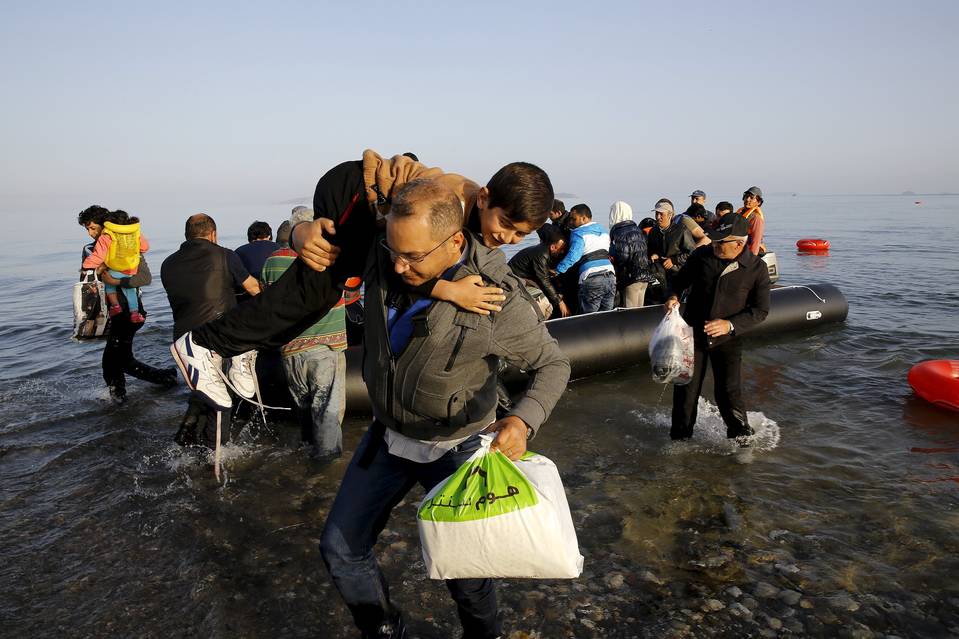
  • According to International Organization for Migration, approximately 48,000 refugees arrived in Greek islands within 5 days (up to October 21st). Greece’s Tsipras agreed on EU’s plan to increase Greece’s capacity to 50,000 refugees by end 2015.
  • According to Spiegel, there was an initial proposal to Greek government concerning the creation of a mega-camp of 50,000 refugees at Athens’ Olympic campus. However, eventually there was an agreement that Greece will increase its capacity up to 50,000 refugees by end 2015, and EU will subsidy the rent for 20,000 refugees.
  • There is still a disagreement as regards the reimbursement of 2 bios euros by end October. Press linkages suggest that this will occur in November and after the completion of banks’ recapitalisation. In addition, Greece needs to meet its December’s obligations to IMF, which amount 1.2 bios euros.
  • Greece’s government published the ministerial decree regarding the implementation of a law which was voted in August, concerning the gradual decree of age of retirement to 62 years with 40 years of insurance contribution or 67 years with fewer years of contributions.
  • According to Greek government’s spokeswoman Gerovassili, there is still a 700 mios euros shortfall for pensions for 2015 and 2016. Although the Greek government insists that there will be cuts in pensions about the threshold of 1,000 euros, there are many publications which refer to pension cuts below this threshold. In addition, the Greek government brought to the table of negotiations, the further increase of employers’ contributions.
  • ECB will announced the results of Greek Banks’ stress tests this Saturday October 31st, at 11.30 am Athens time. This increases the pressure to the Greek government to submit the recapitalisation bill by Friday. As a reminder, this bill should have been ratified by mid –October. A number of reports have been published which estimate that the Greek Banks will need approximately 5-7 bios injection of private funds.
  • According to various banks’ analysts, the total number will reach the level of 15 bios which could be reduced below the level of 10 bios euros, if banks implement their restructuring plans.
  • According to Hellenic Asset Development Fund’s Pitsiorlas, the SYRIZA’s government will push ahead its ambitious privatisation plan which amounts 3.5 bios euros in 2016. At the moment, there are major two projects, which concern a) the privatisation of 14 regional airports to Fraport and b) Port of Piraeus which could be completed by year-end.    
Risk assessment. I remain on my previous estimates that the impact of capital controls will be less than it was initially expected,  and this will facilitate the recapitalisation of Greek Banks. In addition, the probability that Tsipras won't fulfil all his commitments which are included in the 3rd MoU, remains low.

However, there is another factor which gradually plays more significant role, enhances Greece's negotiation power, geopolitical role and if it is handled effectively by the Greek Government, then it could be used as the mean for EU funds' transfer to the Greek economy, the debt's relief and return to sustainable economic trajectory. I'm referring to the ongoing refugees' crisis.

Greece’s leftist government doesn’t face only a series of critical deadlines concerning Banks’ recapitalisation and EU reimbursements to meet obligations to IMF, but also the most significant refugees’ crisis since 1922, when almost 2 million refugees from Minor Asia fled to its territory.
Although there are significant risks associated with refugees’ crisis, if Greek government manage the situation in a constructive way and integrate those refugees in its social net there will be benefits to local economy and society.
In addition, there will be a need for additional workforce when local economy will return to growth trajectory. The question is ‘how this need for labour force is justified by the current high unemployment rate of 25%?’
The main reason is that Greece faces significant demographic crisis, which has not only impacted economic activity but has almost derailed its pension system. This crisis was further deteriorated  due to the ongoing crisis which forced thousands of Greeks to relocate to other EU countries. This relocation was partially due to economic cycle and partially due to skill mismatch. For instance,  according to World Health Organization, Greece holds the second position globally as regards the number of doctors per 10,000 citizens (62 out of 10,000 when it is 35 at EU level). And this contributed to the overall bubble of local economy which busted in 2009.  
Needless to say that structural problems of local educational system combined with cultural problems, unlimited access to borrowing money and black economy resulted to the creation of a scientific ‘proletariat’.
Last but not least, it is highly unlikely that refugees’ inclusion to local social net, will be handled by local state structures. Considering the ongoing restructuring of state sector, it will be extremely difficult to Greece’s state sector to handle such extremely high burden, which is not only associated to capacity issues but to cultural issues as well. It is highly likely that international organisations will be highly involved in matters related to refugees as it happened in 1922 national disaster.

Sunday, 25 October 2015

25th Oct, 2015, Greece’s technical dramatization of negotiations intensifies, amid gradual restoration of interest for investments


  • It appears that there is a disagreement between Greek government and creditors as regards the implementation of measures which are included in the 3rd MoU. More specifically, there are obstacles on taxation of private education and foreclosures’ threshold. This prevents not only the disbursement of 2 bios euros but the Greek Banks' recapitalisation as well.  
  • During his visit in Athens, France’s Hollande reconfirmed his previous position that in case Greece fulfils its obligations which are included in the 3rd MoU, there should be an agreement as regards Greece’s debt relief. He also added that there should be more discussion as regards the threshold for foreclosures.
  • Greece’s current account surplus in August closed at 2.1 bios euros which is 0.232 bios euros higher compared to August 2014. This was due to the reduction of imports by -14.7% and an increase of revenues from tourism by +7.3%. However, the value of exports decreased by -12.8% (due to oil prices’ drop).
  • The number of unemployed Greeks who are seeking employment reduced to 806,429 in September 2015, compared to 815,434 in August 2015 and 823,618 in September 2014. This slight improvement is related to growth in tourism. However, the part of unemployed which remains out of local marketplace for more than 12 months is 456,329 (56.59%).
  • According to the recent report of 'Review of Maritime Transport', the Greek shipping industry maintained its 1st position globally as regards a) total capacity of ships bigger than 1,000 tonnes and b) number of ships. In addition, the Greek ship-owners increased their market share as regards global shipping cargo to 16.1% (compared to 15.4% in 2014). Last but not least, the Greek shipping industry transports approx. 50% of total EU’s shipping trade.
  • The Coca Cola Hellenic which represents Coca Cola’s no2 franchise at global level, announced that OTE (Deutsche Telecoms’ Greek subsidiary) gained the contract to run its datacentre for the next 5 years. In addition, Cocal Cola will transfer its primary data centre from Switcherland to Greece.
  • Renting prices for shops in Greece, are the lowest at European level (even lower than Romania and Bulgaria).  According to data published by the Bank of Greece, the total decrease of renting prices reached the level of 31% during the period 2009-14.
  • Bulgaria’s surplus of current account increased by +23.7% (on an annual basis) during the period Jan-Aug 2015. This was mainly a result of a reduction in trade balance’s deficit (exports increased by +9.1% and imports by +3.7%)  
Risk assessment. Tsipras’ government attempts to return to his drama-style negotiations with creditors. However, I remain on my previous view that the impact of capital controls to local economy will be less than it was initially expected. Gradually, this becomes the view of many international economic bodies and EU Commission, which are now evaluating the reduction of local GDP to less than -1.5% (from -2.5% which was the initial estimate).
It becomes evident that the better-than-expected Greece’s economic performance will impact positively the base scenario of stress tests and eventually the recapitalisation Greek Banks’ which appears to evolve comparatively smoothly. In addition, the interest of private sector on the recapitalisation of Greek Banks will be assisted by
a) the current rate differential between Greek bonds' yield and bonds of other Eurozone countries,
b) the potential for upside, if Greece implements the changes which are included in 3rd MoU
c) the gradual increase of Greece's geopolitical role due to the on-going fluid geopolitical situation in Middle East and
d) the significant increase of competitiveness during the last 6 years. 
Although, local media are conquered by news related to a disagreement on taxation of private education and foreclosures, the most complicated item remains the restructuring of local pension system. However, the possibility that SYRIZA’s government won’t fulfil its commitments is low, considering a) Tsipras has agreed on this item b) pension system' burden is unsustainable and  impacts significantly economy and c) the implementation of pending structural reforms impacts directly the recapitalisation of Greek Banks which needs to be completed by end 2015.
Although there is a need of taxing certain parts of Greek economy which traditionally didn’t contribute to state revenues, it is absolutely necessary to reduce the overall non-salary cost to local enterprises, hidden taxes to overall economy/society and  current taxation to entrepreneurship, pensioners and employees.
Last but not least, the significant increase of citizens and enterprises’ debt to the Greek state by 1.5 bios show that further increases of taxation on the current taxpayers, will only increase private debt and won’t bring additional revenues. 
The fact that 95% of state budget is related to the increase of revenues, compared decrease of expenditure, shows that these SYRIZA’s government policies won’t succeed, and there will a shift to realism soon. This means that sooner rather than later, there will be a significant reduction of state expenditure, starting from pension system which represents its biggest and most unsustainable item.


Monday, 12 October 2015

12th October 2015, Greek leftist government’s first austerity bill will be submitted today

·         ECB’s Draghi stated that there should be debt relief after the completion of current evaluation. During his interview to Kathimerini of Sunday, he mentioned that the discussion regarding debt restructuring will occur only after the completion of current review. Draghi represents the third head of Greece’s troika of creditors, who reconfirmed that Greece’s debt structuring is on the table and discussion will start just after the completion of current review.In addition, he emphasized the need that Greece will implement all structural changes which are included in 3rd MoU, in order that local economy will return to growth trajectory.

·         IMF’s Lagarde reconfirmed from Lima - Peru that IMF won’t participate in Greece’s program as long as there is no agreement as regards debt restructuring. She emphasized the need that Greece will implement structural reforms mainly in pension system and banks.

·         Athens International Airport’s CEO, Paraschis was voted as CAPA Airport Chief Executive of the Year 2015. The International Committee of Centre of Aviation valued highly AIA’s innovation, high standard of service vis-a-vis the reduction of operating cost, reduction of carbon footprint, development of the biggest photovoltaic park in an airport, and dynamic marketing strategy.

·          According to press linkages, the EU is planning to merge all Greek Banks’ subsidiaries in Balkan states by end of 2015. This means that in case there are four Greek banks operating in one Balkan state, they will all merge into one Greek bank. At the moment there are about 2,700 branches of Greek Banks in Balkan states with approx. 35,000 employees. As a second step, each subsidiary will be sold within 2016.

·         Greek exports were reduced by -8.9% in August. It is the third consecutive month of exports’ drop. However, Greece’s trade balance deficit also dropped by -8.8% compared to Aug’14. In general, trade balance deficit dropped by -18.5% during the period Jan-Aug (compared to the same period in 2014). This is mainly due to a higher reduction of imports (-9.9%) vs. the reduction of exports (-3.3%).

·         The reduction of value of exports reflects mainly to the drop of price of fuels. On the other hand exports without fuels increased by +6.8% in August (compared to Aug’14). In terms of foreign markets, exports decreased by -22.4% to countries outside EU, and exports to EU region increased by +8.1%.

·         It appears that Greece Ministry of Finance will roll out a massive plan to minimize cash transactions and maximize bank cards’ usage throughout Greek economy. In addition, the use of bankcards will be the sole mean of transactions for a series of professions which were champions of tax evasion such as doctors, lawyers, plumbers, electricians, builders etc.  

Risk assessment. I remain on my previous view that the current coalition SYRIZA – Independent Greeks won’t last long. Despite the fact that Tsipras enjoys a refreshed mandate, the list of structural reforms which are included in the requirements to complete current review, impact vested interests and require broad political support which goes beyond current coalition. Regardless Tsipras verbal determination, it is still doubtful that the current coalition will finally ratify and/or implement those structural reforms. Considering the verbal objection of all other pro Europe political parties to support this austerity bill, we may see coalition’s first losses during next Saturday’s vote.

SYRIZA’s government will submit its first bill with austerity measures today. It appears that there is one MP ‘Independent Greeks’ (SYRIZA’s ally), who has sent ambiguous messages regarding his final stance during the vote of austerity bill. In addition, there is another MP who resigned from Central Committee of SYRIZA, as an act of protest as regards the way that lists of Party’s candidates were formed before elections. If both MPs either abstain or vote against the forthcoming bills, then the austerity bill will be ratified by 153 MPs (out 300).

It appears, that Greece’s government in an effort to meet budget targets, has chosen mainly to raise taxes instead of cutting expenses. In addition, taxation will be increased across all citizens, regardless if they could tax evade or not. It becomes evident that this will result to the increase of citizens’ arrears and social dissatisfaction.

Last but not least, Ministry of Finance’s Alexiadis announced a series of measures, which will reduce cash transactions and increase the bank cards' usage. Greece traditionally is a cash society which means that this is a structural reform of immense importance, which also includes cultural elements; and this makes it even harder to implement.

Wednesday, 7 October 2015

7th October 2015, Greece’s risk profile has been improved but crisis it ain't over yet

 
·         IMF issued a warning that despite the fact that Greece’s leftish government signed off the 3rd MoU, the risks related to Greek question remain. In addition, it remains in its initial estimates which were showing a GDP contraction of -2.3% in 2015, due to a significant contraction of -5.4% which will occur during Oct-Dec 2015.  

·         Greece’s government submitted in local Commons the budget 2016 bill. It includes increases of taxes and pension cuts which are totalling 4.3 bios euros. The total amount concerning tax increases reach the level of 2.5 bios euros but could be higher considering that the farmers’ bill has not been published yet. 
·         Ministry of Finance’s Alexiadis stated that effective 2016, Greek citizens will stop visiting Tax Offices which has been the standard practice up to now, and represented a source of corruption. This means that all customer requests will be processed either through web or through KEPs (Citizens Service Centers) which are currently servicing a significant part of citizens’ requests.  

·         Ministry of Finance Mardas announced that the local government will implement an existing plan and create a Summer Davos in a Greek island. It will be an Aegean island which will be transformed to a global conference centre and where countries from all over the world, will be invited to ‘adopt’ a building.  

·         It appears that there are three potential buyers of National Bank of Greece’s stake at the Turkish Finansbank. More specifically, the Turkish bank Fibabanka (in cooperation with Societe Generale), Garanti Bank and Qatar National Bank. 

·         The local Council of State decided against the previous government of SYRIZA's decision to partially close down the goldmines of ‘Hellas Gold; hence operations of Hellas Gold restarted. As a reminder, the SYSIZA’s government decided to close down a part of goldmine operations just before September’s parliamentary election, which led the company Hellas Gold’s decision to close down all operations. 
 
·         There was another incident of attack to IRS officers. It occurred in a local religious feast in Northern Greece, where IRS officers found a merchant having an undeclared cashier, which was producing fake receipts for customer transactions. This was the fourth incident of attack to Tax Officers within the last four months.  
 

·         Cyprus is planning to launch a 10 year bond in the coming weeks amid improvement of local economic conditions. Nicosia is planning to raise up to 1.5 bios euros by end of 2015. The announcement came just after the positive evaluation of Cypriot program by its creditors which led to the release of 0.5 bios euros disbursement.   


Risk Assessment. The Greek crisis aint’t over yet. Leftish Tsipras’ government chose to continue its previous alliance with the extreme right political party of ‘Independent Greeks’ amid deteriorating economic conditions and significant political and economic challenges ahead. I remain on my previous views that a) GDP contraction will be less than was initially expected and b) that the current coalition won’t last long.
Greece’s leftish government will need to handle within the following 5 weeks, three major challenges such as 1) evaluation of current program, 2) recapitalisation of Greek Banks and 3) debt restructuring.  This requires broad political consent which doesn't exist, despite Tsipras' recent mandate. Actually Tsipras has already made some kind of steps to bridge the gap (who has created), between SYRIZA and the other centre, centre-left parties PASOK, Potami and Centrist Union.
The Greek leftish government’s first full-year budget is going to be ratified tonight. It is highly likely that tonight’s vote will be evolved without any losses from the current parliamentary majority. However, implementation risks of austerity measures remain. This is due to the following reasons:
·         Budget 2016 includes a significant number of austerity measures, which are in contrast to the populistic rhetoric that brought Tsipras to power.

·         The new set of austerity measures impacts significant vested interests such as farmers and islanders. It is the first time that farmers loose significant privileges, which allowed them to enjoy an almost tax free status. In addition, the new measures impact significantly all pensioners which earn above 1000 euros on a monthly basis. These pensioners come from powerful state sector and other significant social groups such as engineers, lawyers and doctors.

·         At the same time, there is no relaxation of taxes to the regular, loyalist taxpayers. This creates an explosive mixture which could impact a) the implementation of budget 2016 and b) the current coalition SYRIZA – Independent Greeks.